

15 Best Snack Commercials Of The 1980s
The 1980s was a special decade that set the mold for popular culture for generations to come. During those magic ten years, blockbuster films were seen on screen and now easily at home thanks to the VCR, and MTV was totally rocking the small tube, making music visually appealing. With so much to watch, consumers found further comfort stuffing their face with snack foods, and, thanks to clever ads with forever memorable slogans and jingles, were pointed to all the latest and greatest ones.
After The Takeout took its own time machine back to the '80s to drink up the best soda commercials of the decade, it's now time to turn our attention to the best snack ads of that period. Along the way, we'll see what Ralphie portrayer was messily up to before "A Christmas Story," learn a few foreign words to describe the awesomeness of string cheese, and find out exactly what people would do for a Klondike bar.
Hershey's Syrup — Messy Marvin (1981)
Before Peter Billingsley shot his eye out in "A Christmas Story," he was appearing in hundreds of commercials. His marquee role was playing "Messy Marvin" in a long-running campaign for Hershey's Syrup that began in 1979.
As Marvin, the fair-hearted, blue-eyed, and bespectacled kid was always out of sorts, flooding a bathtub, falling into a tub of paint, and more. Yet, when it came to squeezing the chocolate syrup into his milk, he always hit his mark. After stirring it all up, he'd throw it back with pure satisfaction, and certainly with more relish than Ralphie did drinking Ovaltine.
One of the best of Messy Marvin's misadventures was when he presented to his class how to properly make chocolate milk. Of course the sailing wasn't fully smooth, as he knocked off his teacher's wig, as well as the classroom clock into a fish tank. By the mid-80s, Hershey's moved on from Billingsley, but in the following decade the actor admitted to The Tennessean, "people still walk up to me and say, "You're Messy Marvin!"
Carvel — Cookie Puss (1982)
Tom Carvel was heavily involved in making his namesake ice cream chain a success, including lending his own gravely voice to TV and radio ads starting in 1955. While many have dissed his vocal chops, Carvel told the New York Times in 1985, "'You can have a six-foot tall handsome announcer with a perfect voice, perfect diction, perfect grammar. But very few ice-cream buyers look like that. Our commercials are for the people who look like us, talk like us, and sound like us.”
There's no denying the endearing amazingness of Carvel's computerized narration to help sell his space oddity Cookie Puss cake. Even the Beastie Boys were fans, writing in their eponymous book, "The ads were super cheap and seemed homemade, and we loved them. Kind of obsessed with them, really." The band even borrowed the cake's name for one of their forays into hip-hop, 1983's "Cooky Puss."
Klondike Bar— What would you do for a Klondike Bar? (1983)
In the 1980s, Klondike Bar owners Isaly Co. increased production of the bars, and made a national advertising push in 1983 to get the word out, with the company claiming at the time it was the first ice cream brand to run a network campaign. Ad agency W.B. Doner found that that the bars were a hit around Pittsburgh, with vice president Kathy Scholfield, telling the Tampa Bay Times, "We found that people there were obsessed with Klondike bars, that some even got out of bed at 2 a.m., and went to a convenience store to satisfy their cravings." That dedication led the agency to come up with a new jingled slogan that is now an aged old question — "What would you do for a Klondike Bar?"
The ads posed the question to people in the street, who were paid actors, and even offered answers on how to earn one. One of the earliest ads best exemplified the campaign, where a man broke out into an array of simian animal sounds. The ads proved their worth, as sales doubled in a two year span. By 1989, the company took a brief break from posing the phrase that pays. Alas, the brand has never shied away from returning to the question, even enlisting Anna Faris and "Jackass" co-creator Jeff Tremaine to help revive it in 2019.
Peter Pan — It's Peanutty! (1984)
Peter Pan peanut butter has naturally always leaned on popular culture to sell its jars, having used J.M. Barrie's title character for its product that launched in 1928. In a rocking ad from 1984, viewers were invited to a soirée, where the doors fling open, and we're welcomed in by hockey-masked Jason Voorhees, of "Friday the 13th" movie fame. The jingle "Peanut — peanut butter" jams in the background, while we see Captain Hook happily grabbing a sandwich and dancing with his enemy Peter, Beethoven tickling the ivories while having a nibble himself, and Mona Lisa bringing one to her face with a hand below her frame, then giving the screen a knowing wink.
Media analyst Todd Gitlin wrote in, "Watching Television," that ridiculing Mona Lisa is conjuring up "pleasure in the past." He added, "Through such compulsive trashing, the spectacle makes eye contact with the spectator, offering, in exchange for the enjoyment that TV cannot permit, a flattering wink of shared superiority."
Tostitos — The Lone Ranger and Tonto (1985)
Fernando Escandon was a man who wore many hats — singer, actor, newscaster, restaurateur, and pitchman for Frito-Lay's Tostitos tortilla chips since the product launched in 1978. In 1985, the creative minds of Matt Manroe and Diane Fannon at agency Tracey-Locke were inspired by the 1982 Carl Reiner film "Dead Men Don't Wear Plaid," where Steve Martin acted opposite clips of classic noir films, and applied the concept with Escandon inserted into classic baby boomer TV shows.
Great care was put into the ads, to reproduce the sets, props, wardrobe, and lighting, even hiring people who worked on the original shows, to match the essence of these black and white clips. Escandon went toe to toe with straight shooter Sgt. Joe Friday from "Dragnet," "Leave it to Beaver," and the talky and very hungry horse "Mr. Ed." While these were all excellent ads, perhaps the best was the one where The Lone Ranger and his partner Tonto confront Escandon about the chips, and literally grab one from his fingertips.
Polly-O String Cheese — Give me a pizza with nuttin (1986)
In 1976, Frank Baker supposedly invented the fromage known as string cheese, and a decade later, the folks of Polly-O got into the game, advertising its version as "the best part of the pizza without the pizza." In the ad, three teens approach pizzaiolo Fred and ask him for a pizza with extra cheese, but to hold the tomato sauce and the crust. Fred is dumbfounded, telling his co-worker Jimmy, "give me a cheese, with nuttin'," to which Jimmy questions, "nuttin'?" Luckily, Fred has Polly-O String Cheese on hand, which the kids happily eat up to cheers of "bellissimo," "manifique," and "c'est si bon!."
80s ad expert Matt Caracappa surmised the ad's lasting legacy for The News Journal: "Fred the Pizza Man and his three young customers must be credited with turning strange rods of dairy goods into something kids went nuts for. As Polly-O put it, it was the 'best part of the pizza.' Kids across the country nodded in agreement, mostly because our mouths were stuffed with string cheese." The ad was so memorable, that when Fred portrayer John Capodice passed away in 2024, his Hollywood Reporter obituary held space to mention his fine work in the ad.
Mama Celeste — Its-a da crust (1986)
Mama Lizio Celeste first made a name for herself with a tavern-restaurant, before turning to selling the family goods to Italian restaurants across the Chicago area. Quaker Oats bought her out in 1969, but she happily became the face of the brand, including hawking frozen pizzas on television.
In the mid-80s, Mama Celeste disappeared from ads and was replaced by her "fictitious little brother" Guisppe Celeste. The mustachioed character really aped it up, stereotypical Italian accent and all, even trying to claim that he invented the crust, and therefore should have his own photo on the pizza box.
Young brother Guisppe's work hit a nadir in 1986, when he got straight to the pie's selling point — telling the viewers "its-a da crust." He said that Mama told him to leave some for others, and he's limiting himself to just one slice — as he shoves the world's largest slice in his mouth. Guisppe was so beloved that he even appeared unpaid in a flyer for punk rock band NoMeansNo, since a picture of Don Johnson was "unavailable."
California Raisins — I Heard It Through The Grapevine (1986)
Selling dried grapes seemed like a Herculean feat, but Seth Werner at Foote Cone Belding agency came up with an idea that gave raisins a whole new attitude in the 80s. Working on behalf of CalRAB — the California Raisin Advisory Board — they licensed the apt song "I Heard It Through The Grapevine" for $250,000 a year, and put claymation pioneer Will Vinton to work, animating a group of purple grooving raisins.
The first ad, "Late Show," aired in September of 1986, where the cool California Raisins shuffled across a table, to the Motown hit sung by Buddy Miles. They appeared as a snack so hip, they were frightening the likes of chips, pretzels, and candy. The ad immediately became a critical and cultural darling, with many encores, including cameos by Ray Charles and Michael Jackson. It even led to CBS specials, a TV series, and a slew of merch.
The original California Dancing Raisins were retired in 1994, but they have resurfaced. Werner reminisced to Pop Icon in 2018, "I believe mascots are important because they can take an inanimate object, product, or service and humanize it to get people to like the brand."
Oreo Big Stuf — Mr. Big Stuf (1987)
In 1971, Jean Knight asked her titular song character, "Mr. Big Stuf," "who do you think you are?" This doo-woppy hit found new life when Oreo introduced a giant version of its once-popular snack — Big Stuf — in 1986.
The ad, which looked like a deleted scene straight out of "Grease," found a group of cool high schoolers dancing in halls, while holding the giant cookie, as Knight's song was reworked to — "Oreo Big Stuf — who do you think you are?" Greg Mowry played the ultimate cool guy in the ad, the sunglasses-dining Mr. Big Stuf himself, and noted in a YouTube comment, "they thought I was 18 years old, and I booked the commercial. If the executives found out I was 27 years old, they would have fired me."
Little Debbie — Rich Little for Little Debbie (1987)
Comedian Rich Little is a master impersonator, and put his skills to great use in a series of ads for Little Debbie snack cakes starting in 1985. Little aped Robin Leach, visiting a kid's "penthouse" treehouse in search of the "Lifestyles of the Rich and Famous," put on some pounds and make-up to play master of suspense director Alfred Hitchcock, channeled both Oscar and Felix in "The Odd Couple," and borrowed Jimmy Stewart to show a wonderful life filled with Little Debbie's snacks. He even work his pitchman duties back into his own comedy, doing Stewart impersonations, while name dropping Little Debbie.
The best of the ads hailed from 1987, and was essentially a time capsule of the decade. It had Little rapping in Debbie's good name, while channeling Jack Nicholson, Crocodile Dundee, and George Burns, and dancing in both store aisles and the streets. Rich Little continued to do ads for Debbie into the 90s, with one, where he imitated "Twins" Arnold Schwarzenegger and Danny DeVito, even drawing the ire of the film's studio, who threatened to file suit.
Cheetos — Chester Cheetah it ain't easy being cheesy (1987)
In 1986, Cheetos introduced the "cool dude in a loose mood" — Chester Cheetah, with help from the creative minds at DDB Needham Worldwide. While the shades-sporting cool kitty looked laidback, just one sight of Cheetos sent him into a frenzied, hangry tailspin. Chester has starred in hundreds of ads across the globe, and one of the better ones finds him lurking in the urban jungle, spotting an attractive woman with a bag of Cheetos. As he gets "loopholes in his scruples," he rushes in for the bag, only to have his face slammed with a trash can lid, leaving his face in that circular shape. He then closes the ad in disappointment, spraying his catchphrase, "It ain't easy being cheesy."
The snacks-cot became so popular, his feet begat the snack Cheetos Paws and a line of Chester's Snacks, as well as the development at Fox of "Yo! It's the Chester Cheetah Show!" The proposed kids show caused an uproar and petitions, as organizations claimed it "fails to strictly separate programming material from commercial matter." To this day, Chester remains the spokescheetah for Cheetos.
Pop Secret — Sun Bathing Kernels (1987)
General Mills wanted a piece of the microwaved butter popcorn pie, and under its Betty Crocker label, introduced Pop Secret in 1985. It quickly became one of the worst kept "secrets," as consumers bought it up, helping to gain over a quarter of the market share within two years.
General Mills launched a $15 million national advertising campaign, and in 1987 made some fun noise with a clever, animated commercial. The ad showcased sunbathing kernels lubricating in oil and flipping over to pop into popcorn, all set to Ritchie Valens' iconic 1958 hit, "La Bamba." Pop culture enthusiast Dinosaur Dracula aptly noted, "Microwaved popcorn still seemed magical in 1987, but the vision of each kernel being an anthropomorphic beach bum just took it over the top."
The licensing of "La Bamba" in the ad, produced by agency Campbell-Mithun Advertising, was actually years in the making. It just so happened to ride the wave of the song's resurgence, thanks to the hit summer biopic of the same name.
Rice Krispies Treats — So good. So easy. (1988)
Kellogg's Rice Krispies hit shelves in 1928, and eleven years later, employees Mildred Day and Malitta Jensen used marshmallows to find the perfect sticky point to create the the only Rice Krispie recipe that matters. The not-so-secret recipe was printed on the box of the cereal, making it a simple dessert for moms to whip up. By 1987, the product was advertised as a dual delicacy — with the first being the cereal itself, and the second being the treat — with the new slogan, "So good. So easy."
To kids, these tasty bars just magically appeared, with no clue as to the effort put into making them. This notion was cleverly put into play in a TV campaign, where a mom is pretending they're hard to make, to buy her time to read a trashy romance novel, but in reality, they were a cinch to make. To make it look like she "slaved over them," as the voiceover puts it, the mother puts down her book, throws a heavy dash of flour into her face, and a pinch of water from the goldfish bowl. As she leaves the kitchen and delivers the treats to the dining room, the ad closes with wowed adulations from her family.
Milk — It does a body good (1988)
The slogan "Milk ... does a body good" had been used in advertising since about the 1970s. In 1982, the word "it" was wedged between "milk" and "does" in a new body positive ad campaign by McCann-Erickson, launched on behalf of the California Milk Advisory Board.
A majority of the ads featured young kids, posturing in front of a generic gray curtained backdrop, and proselytizing the virtues of drinking milk. One ad in particular that left a mark saw a swimsuited babe being spoken at by a scrawny kid, who started to grew up before our eyes, thanks to milk. By the end of the ad, the kid is now a buff older teen who tells his crush, "when all my work is done, will you love me just for my body?" He then returns to being a skinny kid, who adds, "I can live with that," as he takes a final sip of milk, and is dragged offscreen by a friend. An audioclip of this very commercial resurfaced in an opening scene of the 2016 stage musical version of Bret Easton Ellis's 1991 novel "American Psycho."
In the 90s, the phrase was still on everyone's mind, but it didn't exactly pay dividends. That's when an even more famous campaign by Goodby, Silverstein & Partners launched with the simple question — "Got milk?"
Orville Redenbacher — Overachieving (1989)
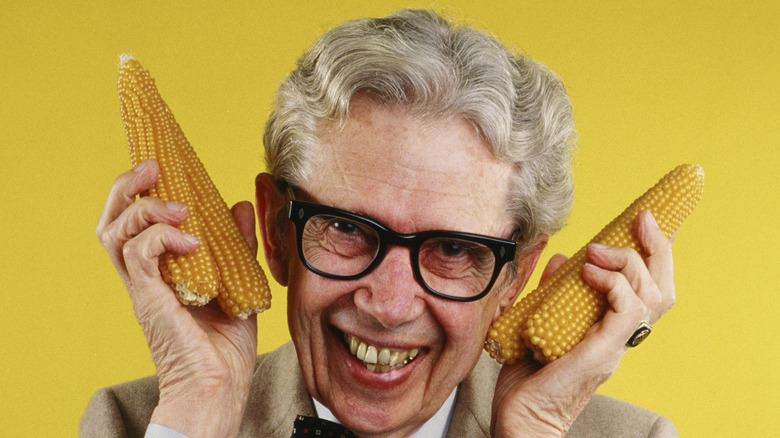
Indiana native Orville Redenbacher and partner Charles Bowman sold their gourmet popping corn as Red Bow, but a wise Chicago ad agency suggested they name it after Redenbacher, and use his likeness on bottles of their kernels. Even after the partners sold their business to Hunt-Wesson in 1976, Redenbacher applied his folksy charm as the brand's spokesman in a series of ads, decked out in his signature glasses, bow tie, and suspenders. William E. Smith, executive director of the Popcorn Institute in Chicago, told the Los Angeles Times in 1995, upon Redenbacher's death, "Many people thought he was a media creation, but what people saw on television, that was him."
In the mid-80s, he was joined in his corny commercials with his even nerdier grandson Gary, who would help him reminisce, and opine on grandad's lighter and fluffier popcorn. One notable ad from 1989 spoke of overachieving, as the duo showed the audience a rare glimpse of Orville as a young man, in an old black and white photo of the then high schooler, completely covered on all the ribbons he had ever earned.